
University Hospitals Dorset: Pioneering the NHS rehab revolution with robotics

Part one: The need for technology within an NHS Acute Stroke Unit
“We must look at how we can enhance rehabilitation with robotics and deliver rehabilitation that is enabled by technology as much as possible.”
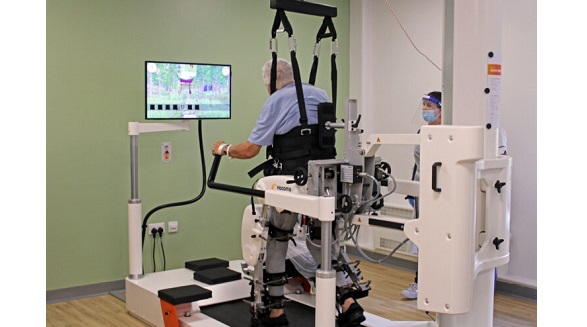
In 2020, University Hospitals Dorset ran an award-winning fundraising campaign for a state-of-the-art electromechanical gait trainer, helping people with stroke learn how to walk again.
One year after the Lokomat was installed in the Acute Stroke Unit, Summit Medical and Scientific caught up with Dr Louise Johnson, Consultant Therapist for Stroke, and Karen Smith, Fundraising Manager, to find out how – and why – they did it.
Tell us about the Acute Stroke Unit at Royal Bournemouth Hospital.
Louise: The acute stroke service at University Hospitals Dorset is one of the biggest outside of London.
We see patients right through the early part of the pathway, so we have a hyper acute section of the ward for people when they’re initially admitted to hospital, and then we provide acute care and inpatient rehabilitation.
We also have an early supported discharge team, which is a community team that provides intensive rehabilitation when people are first discharged home. This service is for up to six weeks.
We admit around 1,200 people every year with a stroke, so we have quite high numbers of people needing our services – a high proportion of those will present with problems with mobility.
The numbers of people admitted every year is increasing, and the general pattern that we are also seeing is more younger people with stroke.
What is the need for robotics within the NHS?
Louise: Whilst more people are having strokes, we are also challenged by limited resources within the NHS. This means we need to use new innovative technology to optimise the therapy we give. For some patients, robotic technology could mean the difference between able to walking again.
There’s lots of ways in which robotics can support service delivery in the NHS.
The first is about delivering rehabilitation that is based on proven experience. We know that there’s strong evidence behind robotics – particularly for walking recovery.
It’s our role as NHS clinicians to deliver care that is evidence-based. So purely on that basis, we should be looking at how we can enhance rehabilitation with robotics and deliver rehabilitation that, where appropriate, is enabled by technology as much as possible.
One of our big challenges will always be that there’s finite resources. We have limited time and staffing capacity, and that will always be the case to some degree.
Robotics help to provide a solution to some of that, enabling us to provide the intensity of rehab that we know is needed to drive recovery for people in a way that is not labour or resource intensive. It helps to meet that challenge and intensity of delivery.
If it’s the right piece of tech for the right population group, then it helps us to use our resources more efficiently. If we can treat somebody with one member of staff, rather than two or three members of staff to achieve the same thing, then we’re delivering more and better rehab to more people, so it provides a solution there as well.
What evidence, research and guidelines were there to support this?
Louise: We looked at the RCP National Clinical Guidelines for Stroke, which is our go-to blueprint for the things we should be looking at for rehab delivery. They’re not extremely detailed but they do provide a list of recommendations, and for walking recovery – one of those recommendations is electromechanical gait training.
For something to make it into the guidelines, it must be based on good evidence. So as a starting point, we can trust those guideline recommendations and should ask why we aren’t delivering them.
We also looked at some of the empirical evidence, and for robotic gait training. The main place is the Cochrane review. This is a very comprehensive and regularly-updated systematic review around gait training. We particularly looked at the studies included here, and the evidence is really compelling so we didn’t need much more convincing than that.
Why did University Hospitals Dorset want to fundraise for a Lokomat in your “Walkerbot campaign” and how did you get to the point where you could fundraise for it?
Louise: The reason why goes back to the evidence and the guidelines, so we are always striving to make sure that we are progressing the way that we deliver rehab and keeping the profile of rehab high.
As a service we are quite proactive at thinking about how we can do things better, and make sure the evidence is translated into practice.
I’d been to a few conferences where robotic gait training was talked about, so over time we felt we shouldn’t ignore it. We are always improving and shouldn’t skim over it in our national guidelines just because it might feel out of reach, or too difficult, or too expensive for us to be able to offer.
We didn’t know that we would end up getting an electromechanical gait trainer like the Lokomat, and that our Walkerbot campaign would be so successful, but we wanted to make sure that we had at least considered it for our patients.
Another reason was that the evidence around robotic gait training is strongest for people who are more impaired after stroke, and who are in the early phase after stroke. That’s exactly the group of patients that we see on our units, day in and day out. It can be challenging to deliver good rehab to these patients because it’s difficult and resource-intensive to achieve intensity with patients who are really impaired.
So, it seemed like a really good fit and a really good solution to a challenge we have in our day-to-day clinical practice.
We just started chatting about it with the team and tested the water before chatting to the charity team, and then it snowballed from there.
Karen: I think it resonated with me that you can save someone’s life from a stroke, and we focus a lot of time and resources and energy on this primary goal, but we also want to invest time and money and effort into funding rehabilitation. So not only have those people had their lives saved, but their quality of life moving forwards will be significantly better as a result of this piece of equipment. For us, funds couldn’t be better spent than for making life-changing differences to people

Part two: Fundraising for robotic equipment in record time
How did you create the “Walkerbot Campaign” for the Lokomat?
Karen: Fundamentally, we first thought about how we could raise the money for the Lokomat. With major campaigns like our Walkerbot campaign, you can break it down into what percentages you need from which fundraising avenue: individual, corporate, and community group giving.
We initially spoke with the Alan Miller, Charitable Trust who very generously made a large donation, which was a launch pad for the rest of our campaign.
We also received charitable grants and formed an individual giving campaign. We put information about the fundraising effort in our outpatient mailings which was a really good way to raise money, and also people who climbed Ben Nevis on the behalf of the charity fundraised for the Lokomat.
The results of this campaign were better than we could have hoped for because not only did we meet our target, the staff and patients it will help, were involved every step of the way.

You raised the funds within just 20 months. How did you connect with the audience so successfully, and through a pandemic?
Karen: We started with a Walkerbot campaign launch in March 2020 where top executives and clinicians spoke. Steve Fletcher from AFC Bournemouth joined us and we invited some of our top potential fundraisers. We spoke about the equipment and the impact it would have on patients moving forwards.
After the successful launch event we had a lot of donations coming in, and then obviously the pandemic hit.
We just stopped and didn’t pick it up until sometime later.
It was incredible once we started again. I remember being in the charity office and people were ringing up donating thousands because they weren’t able to go on holiday, so they were donating to the Walkerbot campaign instead.
Stroke touches a lot of lives, and there aren’t many families that stroke hasn’t impacted in some way. So, as a relatable and engaging campaign it ticked a lot of boxes and picked up a lot of momentum.
Louise: I think it’s very emotive, being able to walk again after any kind of devastating illness. People can identify with that and see where this technology would help people. That’s a really clear link so I think that makes it easier to explain the benefits to people.
Karen: And I think when it came to the name of it, I think one our team members came up with “Walkerbot” which helped create a strong brand and design.
When you’re trying to fundraise for a piece of equipment, you have to make it recognisable and clear to someone who has no idea what it is. You need a clear image, a strapline, and a strong brand so people can identify and comprehend what you’re raising money for and the actual difference it will make. You have to take them on that journey, so they identify with the equipment and want to make a donation.
What advice would you give to others looking to fundraise for robotic equipment?
Karen: While we need to be aware that times are hard for everybody including supporters right now, I’d say don’t be frightened by the amount of money you need to raise, because £365,000 can be really daunting. You can use every income stream available to you to fundraise. If you’ve got a stroke fund within your department, you can caveat your campaign and say if we raise above the target, it will go to the stroke fund. In the same way, you can say your intention is to raise money for this equipment, but if we don’t reach the target, it will still go towards stroke rehabilitation.
My second tip would be to have clear messaging about the benefits of the equipment for patients and therapists. It might take two therapists to allow a patient to take 20-30 steps in a session but by using a Lokomat, we can achieve hundreds if not thousands. This isn’t replacing therapy – it’s enhancing it and enabling patients to go so much further in their therapy.
Louise: If it takes time to raise the money, that’s ok! The sooner you start, the sooner you’ll get there. If you procrastinate forever, then we’ll never progress anything. “Get on with it” is what we say!
Karen: It also helped us to visit the Wellington Hospital and see the Lokomat being used there. I was the project manager for the campaign, but I took our whole team to see it, which meant they can see first-hand the benefits of the equipment. It was so worth an afternoon of our team’s time to see it in action.
Likewise, if you’re interested in seeing our Lokomat, you can come and visit us now. Please contact our Charity on 0300 019 4060/8449.
You also need a good clinical lead. We were blessed to have Louise driving it forward, because ultimately it wouldn’t have gathered the momentum without the passion for research and the service we want to provide. With regular meetings and communication between teams, you’ve got to be engaged and give it the time.
Louise: You need a clinical lead who is brave enough to say; “We should have this, we should do this.”, and you do have to sell that little bit. There are always people who are going to have doubts about the value of the equipment or are going to ask challenging questions. You just need to be informed, able to respond to those challenges, and open to finding solutions.
It might feel like a lot of money to us therapy teams because normally we just have gym balls and Zimmer frames, which don’t cost very much. However, it’s actually not a lot of money in the context of the NHS and its invaluable equipment for our patients. You need to have the confidence to say that. It does feel like sticking your head above the parapet a little bit, especially being the first Trust to do this, and I did spend a lot of time wondering why nobody else had this equipment?
In rehab we’ve got to be more ambitious. We’ll never progress or keep the profile of rehab high if we don’t pursue these opportunities.
Part three: Walking towards the future of stroke rehabilitation
“The [Lokomat] was invaluable in aiding my ability to be able to walk again. Using it gave myself and my body the strength, stamina and confidence to keep on trying when I was at the lowest point of my life.”
How do you use the “Walkerbot” with your patients?
Louise: When a new piece of equipment arrives, that’s where the hard work begins.
It’s important for people to recognise you do have to put in the work making sure something becomes embedded in your service.
Trying to introduce new equipment in the middle of a pandemic was really difficult timing. It arrived in October 2021, and by December through to February we had our worst months throughout the pandemic. So, we had to have a phased introduction to using the Lokomat with our patients.
In response, we’ve organised our systems and have a screening tool for all patients who come through the unit with leg weakness. We are quite broad in our thinking of who we might recommend for Lokomat training. All the clinical team and therapists are aware of the criteria and know what the equipment does. Even those who aren’t trained users are really familiar with where the device would sit in a patient’s rehab programme, as they’ve seen patients using it.
We try to identify patients early in their recovery, from 5 days post-stroke. Some patients might not be ready at this stage but have them on our radar and conduct an initial assessment. We’ll share this information with the patient and talk them through what the Lokomat is, why we are recommending them for Lokomat training, and how it can help them with their rehabilitation. We also find it’s helpful for patients to see other patients using it.
We make sure we’re really clear that this isn’t a magic bullet, we don’t want to falsely raise people’s expectations. We continue to practice standing and stepping in a more conventional way, in addition to Lokomat training.
We continually review a patient’s progress, and we are quite sensitive about how we manage their journey as sometimes the bigger challenge to work out is when they are ready to stop using the Lokomat and progress onto the next stage of their therapy.
Generally, people aren’t daunted by the equipment, and they’re itching to have a go.
We do the initial assessment with two clinicians because the patient is in the acute stage. Two people means we can set them up as quickly as possible. From there we work out an individualised rehab plan for that person and, depending on the patient’s ability, one member of staff can take it from there.
We have a minimum aim of 3 sessions a week, which works well for our patients as it incorporates well into the other areas of their stroke rehabilitation. Every other day also helps with energy levels when someone is quite early after stroke.
Families always want to come in and watch, which is nice. People are sometimes quite emotional when they start walking in the Lokomat, because it will be the first time they’ve walked after they’ve had their stroke.
We’re always surprised by how well patients tolerate the rehab, it’s hard work which is what we want for patients and they get something from the feeling from working hard. We know this drives those endorphins and is motivating which is why exercise is so good. Int this acute stage patients are not getting that in any other way so they’re really needing that positive boost.
What does a typical session look like?
Louise: It takes around 10 minutes to set a patient up in the Lokomat. Each patient has their rehab programme saved for them on the machine, where we tailor the machine’s settings and the interactive games to their needs.
Once the patient is walking, the machine does all the hard work for us so we can keep an eye on the patient, give them feedback and encourage them. We can see how each patient is progressing and how to challenge them.
The session can last anything from 10 minutes, up to an hour depending on where the person is in their recovery. We start small and build up from there.
At the end of each session we share the data with the patient. What’s great is we can immediately show them what they’ve done, how long they’ve walked for, and how many steps they’ve taken. Patients are really competitive with themselves and want to know if they’ve done more than the previous session.
They love the scores on the games which help them see if they’re improving.
When the patient comes out of the Lokomat, we often practice some standing and stepping immediately, making sure we are translating the movements they’ve been practicing in the Lokomat into the real world.
How has the “Walkerbot” affected therapists?
Louise: The pandemic has meant at times we didn’t have the provision to focus on rehabilitation. The Lokomat has really regenerated the team and their passion for the importance of rehab.
I can’t imagine being without it now. You can’t imagine going back to what you did before, but you don’t know that until you’ve had the opportunity to use it.
For those who are Lokomat users, it’s given our staff a development opportunity, learn new skills and deliver something differently and innovatively. Therapists get satisfaction from seeing patients doing well, and being part of that process with patients who are so grateful for the opportunity to use it, it’s extremely rewarding for the therapy team.
It helps our unit become somewhere people might want to work or stay working. It’s not just about the robot – it’s about being at the forefront of rehab delivery.
It’s brilliant for morale, it’s brilliant for the profile of rehab, and anything that is good for patient recovery is what gives healthcare staff satisfaction.
What difference has it made to the Acute Stroke Unit? What results and outcomes are you seeing?
“My stroke stole my ability to walk, strapped into the Walkerbot I could walk again. It was fantastic. The Walkerbot also allowed me to exercise my weak leg in ways that were impossible outside of it. As a result of this my leg grew stronger and I can now walk with a frame.”
Louise: We are seeing really positive outcomes and benefits for patients.
It can be quite hard to measure and quantify, but for some patients having intensive therapy means they progress quicker, they’re in hospital for less time, and they’re able to go home and continue their rehab in the community more quickly.
You can never really know whether someone would have improved without the gait trainer, but we certainly have patients who are surprising us with their achievements, and getting back to walking when we might not have predicted it.
The way the Lokomat really helps with training of physiological gait is that we’re improving people’s patterns of walking.
There are other added benefits too. The Lokomat enables patients to exercise and help with their cardiovascular fitness, because if you’re immobile it’s difficult to exercise outside of the Lokomat.
One patient in her 90s came in to use the Lokomat, and at the beginning could walk for three or four minutes until she was out of breath. By the end of the programme with us she’d be comfortably walking for 40 minutes. This meant when she was home, she could go out, enjoy her garden, walk to the car, go to the hairdressers etc – all those everyday things we take for granted!
She just didn’t have the exercise tolerance or strength for that before. So the benefits are much broader than just walking again, you can also get to the level where you can be out and about in the community again.
We’ve had patients with lovely goals, such as one of our first patients who wanted to walk his daughter down the aisle when she got married. He’d already been in hospital for quite a while and had rehab for a couple of months at home and six weeks of rehab with the Early Support Discharge team. When he came in to use the Lokomat, he was quite a while post-stroke and could take just a few steps with aid. He was working with us for a few months and did indeed walk his daughter down the aisle. I truly believe he would not have achieved that without the Lokomat, and that’s what it means to people. It’s about giving them their quality of life back.
There’s also something very important about somebody’s mindset. It gives people the motivation to do more in the rest of their rehab as well. It gives people hope to carry on, because rehab is hard work. You have a stroke and it’s devastating, and you really have to work hard at getting better.
Even for patients who don’t make a good recovery, we are seeing that it can help with their process of acceptance. They know they’ve had the best opportunity. Some colleagues were concerned that allowing someone to use a high tech machine gives false hope for patients who won’t make a full recovery. But we don’t find that at all. As long as you manage those conversations well, it really does help to know a patient has had the best opportunity and that allows them to accept the disability they have.
What’s next?
Karen: Bringing in the Lokomat, and achieving the fundraising in difficult circumstances, now means we can consider more campaigns like this in the future. The tilt table campaign [for the Hocoma Erigo] has come out of the Walkerbot campaign, which generated so much enthusiasm and the potential to add more technology. The tilt table can be used by the most unwell patients, and not just stroke but other patients recovering from comas or neurological conditions. And it all integrates so you can move a patient along to the Lokomat as they progress.
Louise: The tilt table will be something we use with patients who just aren’t quite ready or stable enough yet to tolerate the Lokomat and using the tilt table will help build their stamina to then be able to do that.